Australia has often been lauded as having one of the highest minimum wages in the world. However the real value of our minimum wage must be measured relative to the high cost of living in Australia, and the overall level of wages.
The Centre for Future Work unpacks Australia’s minimum wage relative to other OECD (Organisation for Economic Co-operation and Development) nations.
Prepared by the Centre for Future Work, March 2024
For many years the common charge from business groups and conservative commentators has been that Australia’s minimum wage is among the highest in the world, making Australian firms uncompetitive with businesses in other OECD nations. However, such claims ignore that Australia is a high-income nation, with an economy characterised by high general levels of both prices and wages. The real value of the minimum wage must be measured relative to the high cost of living in Australia, and the overall level of wages.
Australia’s minimum wage ‘bite’ relative to OECD countries
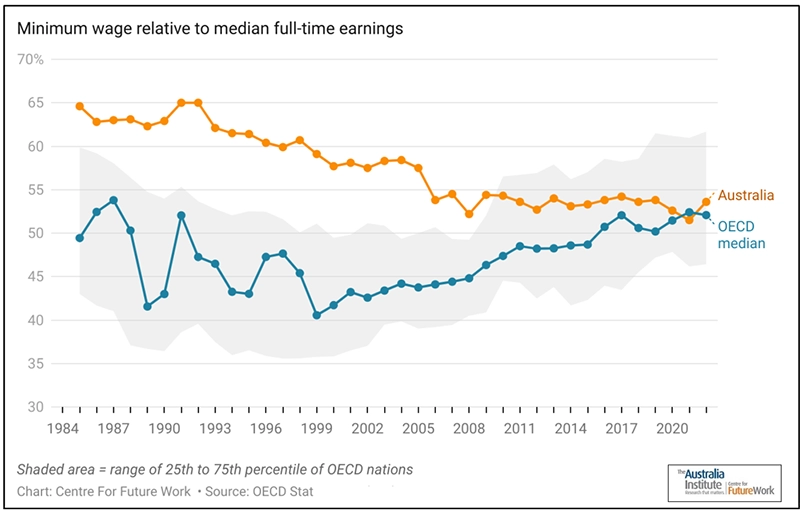
The best way to compare minimum wages across nations is to compare minimum wages to the overall level of wages in the economy. The “minimum wage bite” is defined as the value of the minimum wage relative to median earnings. (The median wage is the amount earned by the worker at exactly the 50% mid-point of the wage ladder; it is a more accurate measure of ‘typical’ earnings than the average wage.) The minimum wage bite indicates how important minimum wages are in lifting overall wages. On this score it could be argued that until the 1990s Australia did indeed have relatively high minimum wages. Australia ranked among the top industrial countries in terms of its minimum wage bite.
Over the past thirty years, however, the relative value of minimum wages in Australia has declined. Meanwhile, governments in other industrial countries in recent years have put more emphasis on higher minimum wages as a strategy for lifting incomes and reducing inequality. For example, the EU recently promulgated a new Minimum Wage Directive which instructs member states to strengthen minimum wages (both statutory and through collective bargaining).
With Australia reducing its minimum wage ‘bite’, and other countries strengthening minimum wages, our minimum wage ‘bite’ has now fallen almost to the OECD median (see figure). In other words, where Australia once possessed one of the strongest minimum wages in the OECD, relative to overall domestic wages and prices, today our minimum wage policy is just average.
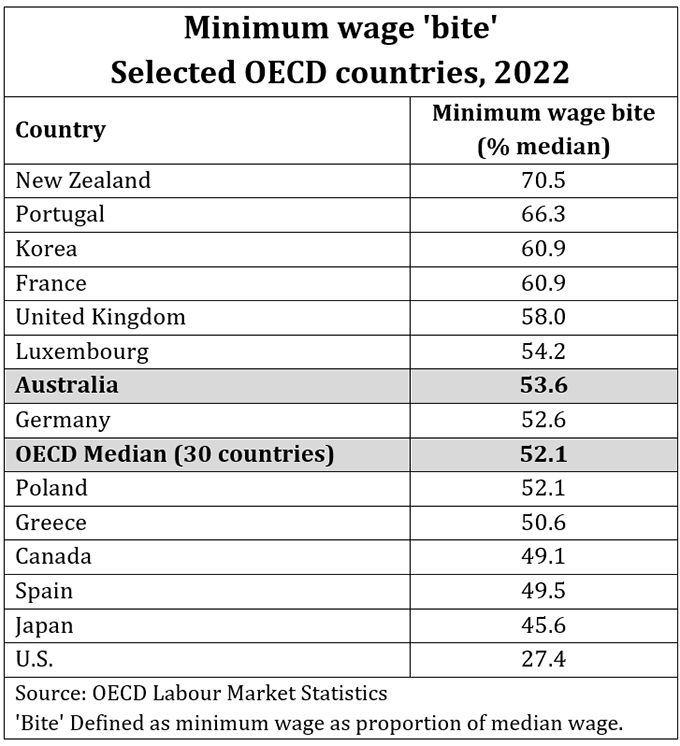
The table indicates the most recent data on minimum wage ‘bite’ for selected industrial countries, comparing minimum to median wages for several of Australia’s major competitors. Australia ranked 13th out of the 30 OECD countries with a minimum wage in 2022. Many countries (including New Zealand, Portugal, Korea, France, and the U.K.) have more ambitious minimum wage policies. Australia now ranks only slightly above the ‘OECD Median’ – which shows the country right in the middle of OECD countries with a minimum wage. (Some countries, like Italy, have no formal minimum wage since almost all wages are determined through industry-wide collective agreements, or an effective floor is set for wages through universal income guarantees.)
In sum, there is no evidence to suggest the minimum wage needs to be suppressed in order to maintain international competitiveness. Over the last two decades, most nations in the OECD have been increasing their minimum wages relative to overall labour market trends. Australia is an outlier, by having lowered its minimum wage so much relative to median earnings over the past generation. More fundamentally, the idea that minimum wages need to be suppressed in the interests of global competitiveness is far-fetched. Most Award-covered workers are employed part-time, mostly in non-tradeable service industries (including public and community services) that do not participate directly in international trade. Keeping these workers even poorer can hardly be a strategy for global success.