
Together, we’ve secured a significant outcome for NAB members on annualised and packaged salaries.
In 2023, the FSU commenced proceedings against National Australia Bank in the Federal Court of Australia. We took this action because members on annualised or packaged salaries (e.g. Group 3 and above) were raising serious concerns about being required to work unreasonable additional hours.
Members said the hours were impacting their physical and mental health, as well as their families and relationships.
Together, we have now secured significant reforms.
This is a historic win for our members. It will help fundamentally change the way additional hours, workloads and role expectations are managed at NAB — and ultimately across our industry.
Read a joint statement by NAB and the FSU on this matter here.
The proceedings were commenced to address the systemic and harmful additional hours being worked by NAB annualised salary employees.
The issue emerged in 2020 while the FSU was pursuing NAB in relation to historic underpayments (see section on ‘’unpaid wages and entitlements’ below). Through that work, we identified a broader and serious concern affecting members on annualised, or packaged, salaries.
Members said they were routinely and systematically being required to work additional hours to complete the business-as-usual requirements of their roles and there was a growing culture in which additional hours were treated as a normal expectation of the role.
Packaged employees are paid an annualised salary, which means additional hours are generally considered to be absorbed into their salary rather than paid separately as overtime.
However, a packaged salary does not mean unlimited hours. Under the Fair Work Act, employers can only request or require employees to work reasonable additional hours. Whether additional hours are reasonable depends on a range of factors, including the impact on an employee’s family responsibilities, health and wellbeing.
Where a request to work additional hours is unreasonable, an employee has the right to refuse.
The FSU took action because members were reporting that the hours required to complete their roles were unreasonable and causing real harm. This included impacts on members’ physical and mental health, family time, caring responsibilities, recovery from work and personal relationships.
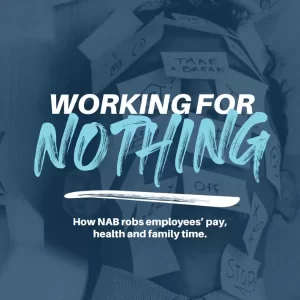
Working for nothing
Following the release of the report, members called for action.
When NAB failed to adequately acknowledge or address the concerns raised, members resolved to escalate the matter. In 2023, the FSU commenced proceedings against NAB in the Federal Court of Australia.
The purpose of the proceedings was to secure changes to NAB’s approach and systems so that employees were not required to work hours that caused harm to them or their families.
The case was supported by the evidence of four witnesses – all FSU members – whose experiences helped demonstrate the impact that excessive additional hours were having on workers’ lives.
The proceedings were focused on whether NAB’s systems, expectations and workload practices were requiring employees to work hours that were harmful and unreasonable. The aim was to ensure that annualised salaries could not be used, in practice, to normalise excessive workloads or leave employees carrying the health and wellbeing impacts of unmanaged additional hours.
Our objective was to secure changes to NAB’s approach, systems and governance so that additional hours are properly identified, monitored, reduced and addressed.
In taking this matter forward, our focus has always been on ensuring members’ health and wellbeing are properly prioritised. No one should be expected to put work ahead of their health, their family or their capacity to recover from work. hours required to complete their roles were unreasonable and causing real harm. This included impacts on members’ physical and mental health, family time, caring responsibilities, recovery from work and personal relationships.
Since the proceedings were filed in 2023, the matter progressed through the usual court processes, including procedural directions and preparation for the next stages of the case.
As part of that process, the Court directed the parties to participate in mediation. Mediation is a normal and constructive part of proceedings like this. It provides an opportunity for the parties to discuss the issues in detail and work towards a resolution.
That mediation process has now resulted in a significant outcome for members.
This outcome includes a worker-led, health and safety-focused approach to reducing and removing unreasonable additional hours from roles at NAB, an industry-leading framework that recognises additional hours as a risk to physical and mental health, new rest and recovery leave provisions, and union engagement and oversight in governance, monitoring and intervention.
In 2019, the FSU commenced a dispute with NAB over the underpayment of wages and entitlements to members. A payroll review confirmed the union’s concerns, and NAB’s payroll remediation program commenced later that year for both current and former colleagues.
Since then, NAB has been forced to make substantial provisions and incur significant costs to repay current and former employees, including:
The total cost of the program is still not finalised.
Payments continue to be made as additional underpayments are identified.
Union members have been central to securing this outcome by exposing the issue, talking to their colleagues, and keeping sustained pressure on NAB to repay employees and remain accountable.
The union continues to represent members and meet with management to ensure these failures are not repeated.
No related posts found.