“In my opinion, gender equality is about including and taking care of everyone, addressing the issues that affect us because we are intrinsically linked. Elevating women does not mean minimising men.”
– Leia Scully, FSU member

“In my opinion, gender equality is about including and taking care of everyone, addressing the issues that affect us because we are intrinsically linked. Elevating women does not mean minimising men.”
– Leia Scully, FSU member
Gender equality is a top priority for our union and underpins so much of the work we do to make our workplaces and communities safer and more equitable. It has also been a defining focus of the Albanese Federal Government’s legislative agenda over the past three years.
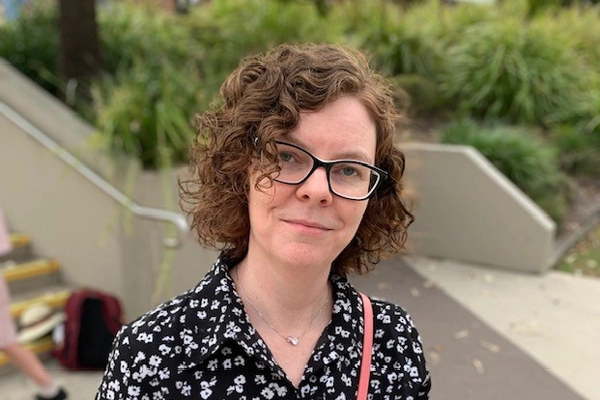
FSU member Leia Scully shares some of her personal views on gender equality. She outlines how her experiences have shaped her world view. Importantly, she discusses how changing our systems and structures is not enough, and that we must all question our internal biases if we’re to make true and lasting progress.
Find out more about the FSU’s Smashing the Gender Pay Gap campaign and get involved here.
If the following content raises any issues or concerns for you, help is available via these helplines. If you are in immediate danger please call 000.
What does gender equality mean to you and why are you passionate about it?
I’ve seen an unconscionable amount of injustice towards others, in different variations, and for myself quite recently, which has forced me to confront my own internalised misogyny and reassess where I stand with gender equality.
Upon reflection, I realised as a child I had associated and internalised femininity as weakness. Toxic environments foster toxic thoughts, and I unconsciously carried this with me for most of my life. It wasn’t until my 30s that things changed, and I realised I was contributing to the problem.
So I am passionate about gender issues because I’m angry I was conditioned this way. I am angry domestic violence rates are increasing, and more women are getting murdered more frequently – every 10 minutes, per a 2024 UN Report.
I am angry that the vast many cultures and religions somehow universally share the same tenet that women are lesser and subservient, which translates into laws and social norms that govern the world, eventuating into things like sexual violence, limited or no education, and gender pay gaps.
I am angry that a convicted rapist was elected President. I am angry that we are watching hard-won rights getting rolled back, and history quite possibly repeating itself.
I am angry that the justice system is broken and perpetrators get to walk free, with little or no consequences. I am angry that this cycle will continue because disenfranchised young boys are becoming more radicalised, leaning conservative, idolising abhorrent figures and adopting their ideals to dehumanise women and gender-diverse people.
In my opinion, gender equality is about including and taking care of everyone, addressing the issues that affect us because we are intrinsically linked. Elevating women does not mean minimising men. It’s about caring and nurturing young boys so they grow up to be good men, who can regulate their emotions. Teaching young girls to advocate for themselves when they’re uncomfortable and feel safe to say no, without having to be stand-offish as a defence mechanism to ward off creeps and potential stalkers.

How have you channelled this anger into contributing towards meaningful change?
In February 2023 the Australian Government implemented 10 days’ paid family and domestic violence leave. Unexpectedly, one month later I had to use this leave to deal with issues forced on me by my childhood aggressors.
I have found comfort, solidarity and inspiration connecting with other remarkable women across the trade union movement. While attending the Union’s NSW Women’s Conference recently, I met the incredible women from the FSU and ASU who worked on this for eight years and were responsible for making it a reality. Listening to guests from Burma share their experiences resisting oppression and sexual violence faced by women in militarised societies. Hearing stories of the trailblazers in women’s health in Australia; other women working in male-dominated industries without proper bathroom facilities.
It was awe-inspiring, and my takeaway was that it is possible to achieve and progress change, one small step at a time. It’s complicated and convoluted, but resilience, community and solidarity is so important, and I want to contribute in any small way that I can. I want to advocate, pay it forward, and be there for women, the way I couldn’t be there for people like my mother.
What has been your experience with discrimination in the workplace?
I have never experienced blatant and obvious discrimination in the workplace. However, it was subtle and fleeting microaggressions that made me question if I was, or just me in my head overthinking again.
As a former forklift driver, even in a supportive workplace, there was still something unspoken about being the token female, and especially one of Asian descent. I couldn’t make mistakes, otherwise I would reinforce stereotypes about female Asian drivers. Most male colleagues were really cool, but some I could tell felt uncomfortable in my presence.
My experiences in white-collar jobs have also been mostly positive, but I have struggled with an authority gap. I don’t mean as a manager because I have not worked in a leadership role, but in the past while performing normal duties, I encountered some conflict with vendors who did not take me as seriously as other colleagues. They would undermine or even ignore my requests, and seemingly deliberately spell my name wrong in emails.
A recurring pattern across these industries is that people/organisations will push the boundaries of what they can get away with. If we as a collective don’t call out problematic behaviour, then we are enabling it to get worse and become normalised. I don’t want to be a bystander anymore.

What are your thoughts on Australia’s gender pay gap?
The recent results about the gender pay gap are encouraging. According to WGEA, the pay gap in finance has dropped by 4% in just one year, while previously it has taken approximately five years for the gap to improve that same amount.
I value being informed and scrutinising information. Although the results are promising, I am weary of companies who may cherry-pick or take their data out of context, to present it in a more flattering light. There is a lot of confusion and misconceptions about the pay gap, so being resourceful and helping yourself or others understand is a small thing that can have a big impact.
Recent actions such as pay transparency laws seemingly have a positive effect. However, this means I am hyperconscious about the upcoming election, and if progress will be repealed and regressed, depending on the government elected. Seeing the horrors unfolding in America, I am deeply concerned about that rhetoric starting to emerge here in Australia.
What needs to change and how can we get there as a society?
Gender should not be adversarial. Childhood experience informs our beliefs, biases and behaviours as an adult, for better or worse. A girl who was taught that mistreatment from boys is a sign of affection, what happens to her? What about boys who are not allowed to cry or express their emotions, or who can’t process rejection? As adults we continue the cycle, seek out what is familiar and become ticking time bombs.
I would like to see the social narrative change. I would like to see systems change. I would like people to hear words like ‘feminist’, ‘trigger’, ‘pronoun’, or ‘patriarchy’ and not roll their eyes. I would like to see people questioning their knee-jerk reactions and wonder if those beliefs remain valid and still serve them.
I often think about my mother and wonder if there had been better support systems in place whether things would have turned out differently. Even though she’s no longer here, I keep her memory alive and stubbornly hope to see a better world for everyone, but especially others like her.
Latest news FSU event: Tanya Plibersek joins us to launch The Leave Revolution.…

Westpac wants Australians to believe they are serious about gender equality. They talk…
“The thing about women retiring with less super than men is that there…