14 August 2026
Meeting to discuss RBA’s response to our claims
Following RBA employees rejecting management's first sub-standard offer for our new Enterprise Agreement,…

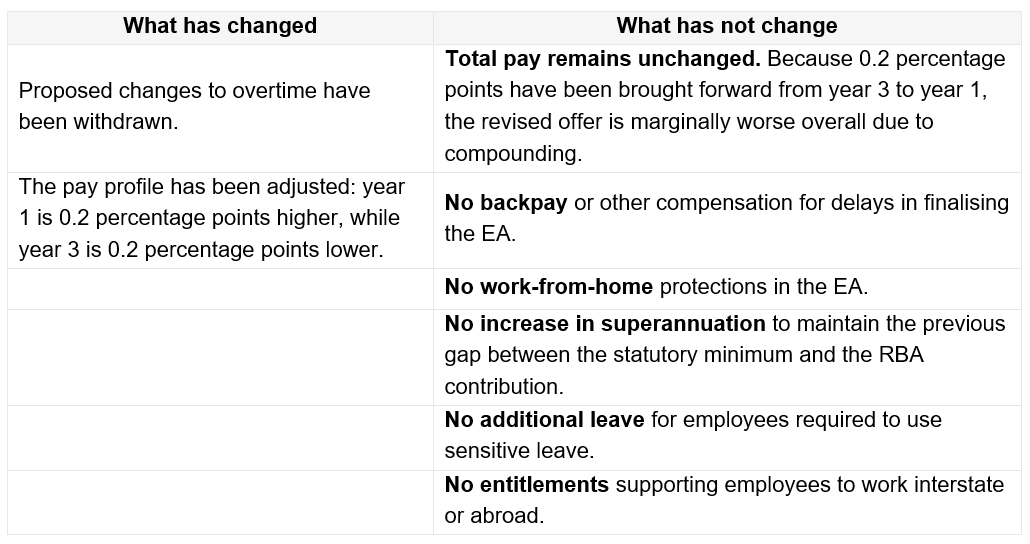
The RBA has refused to listen to workers after we rejected their last Enterprise Agreement offer. Now, instead of addressing our concerns, they’re putting forward a near-identical offer in the hope that we’ll change our minds.
Therefore, FSU members are recommending that staff vote no in the ballot, which opens from 15 – 19 October.
Voting no does not necessarily guarantee a particular outcome, but it does force RBA management to continue negotiating, and gives employees the opportunity to secure a better offer. Voting yes closes that opportunity and locks in the current unsatisfactory offer.
Please read the below FAQs before casting your vote on 15 October.
RBA workers are also encouraged to join our private employee information forum – a Microsoft Teams channel that has been set up by RBA employees for RBA employees. It’s your place to ask questions and be part of the conversation – join here.
For a proposal to be accepted and become an enterprise agreement, a majority of employees who vote must vote yes.
A yes vote would lock in the current proposal, subject to Fair Work Commission approval, and end negotiations for this agreement.
A no vote would mean the proposal is not accepted and bargaining would resume.
Voting no does not necessarily guarantee an improved outcome, but it does force RBA management to continue negotiating, and gives employees the opportunity to secure a better offer. Importantly, a stronger no vote than the one in June would show that the current proposal has not won staff support and gives bargaining representatives a clearer mandate to continue pressing the RBA for improvements.
An enterprise agreement is legally enforceable and sets minimum terms and conditions.A workplace policy does not provide the same security and can be changed by the employer. That is why important protections, such as flexiblework protections and work from home arrangements, are more secure when includedin the EA.
The RBA cannot make this agreement without majority support from all of us who vote. Individually, we have limited bargaining power. Collectively, our votes, participation and willingness to take lawful action give us leverage.
A strong no vote – in other words, a significant percentage of employees voting no – would give all of us and our bargaining representatives a clearer mandate to keep bargaining for improvements.
Union members also have the option of taking protected industrial action.
Protected industrial action can only be taken by union members after it is voted on and lawfully authorised by the Fair Work Commission. Union members have the option to take protected industrial action during enterprise agreement negotiations as a way to pressure their employer to improve their offer and take their concerns more seriously.
Examples of protected industrial action may include:
Members would decide collectively what action to support, with formal union guidance before any action is taken.
Union members shape bargaining priorities through surveys, polls, member meetings and direct feedback to our bargaining representatives.
Employees who are employed at the time of the vote and will be covered by the proposed agreement (Levels 1-4) can vote in the upcoming ballot from 15 – 19 October. The agreement is made if a majority ofemployees who cast a valid vote yes.
Yes. The RBA can advocate for its proposal, and staff should expect it to do so. Good-faith bargaining does not require either side to be neutral, make concessions or reach agreement. Staff are equally entitled to assess the proposal critically, organisecollectively, and campaign for a better outcome.
Negotiations for a new APS Enterprise Agreement are ongoing, and union members there are seeking a 5% pay rise each year of the agreement or CPI, whichever is higher.
The Commonwealth is expected to put a pay offer to APS bargaining representatives on 13 October, but this offer is not a final agreed outcome.
Therefore, RBA staff should not view this initial offer as being accepted by APS employees or as a settled benchmark for our own agreement.
Treasury’s Enterprise Agreement shows that stronger flexible work protections can be included in an EA. It states that requests are to be considered case by case with a bias towards approval, and that Treasury will not impose group caps on approved work from home or remote work.
The RBA has not agreed to equivalent protections in its proposed agreement.
No. Treasury can still refuse an individual request on reasonable business grounds. The important difference is that its EA rules out blanket group caps and requires a bias towards approving requests. Those are meaningful protections that RBA staff areseeking in their EA.
The current CBA proposal is tiered and does not appear to provide a simple 9.5% increase to all employees. It is therefore not a clean like-for-like comparison. The stronger argument is the substance of the RBA offer and the improvements staff are still seeking, rather than relying on a headline figure from another employer.
The RBA declined the FSU’s request to share its bargaining minutes with RBA staff. However, you can read the FSU updates from each bargaining meeting on the Employee Information Forum Teams channel.
Following RBA employees rejecting management's first sub-standard offer for our new Enterprise Agreement,…
The results are in, and a majority of us voted NO to the…
Voting for the RBA’s proposed Enterprise Agreement is now open. Our union is…